Use case
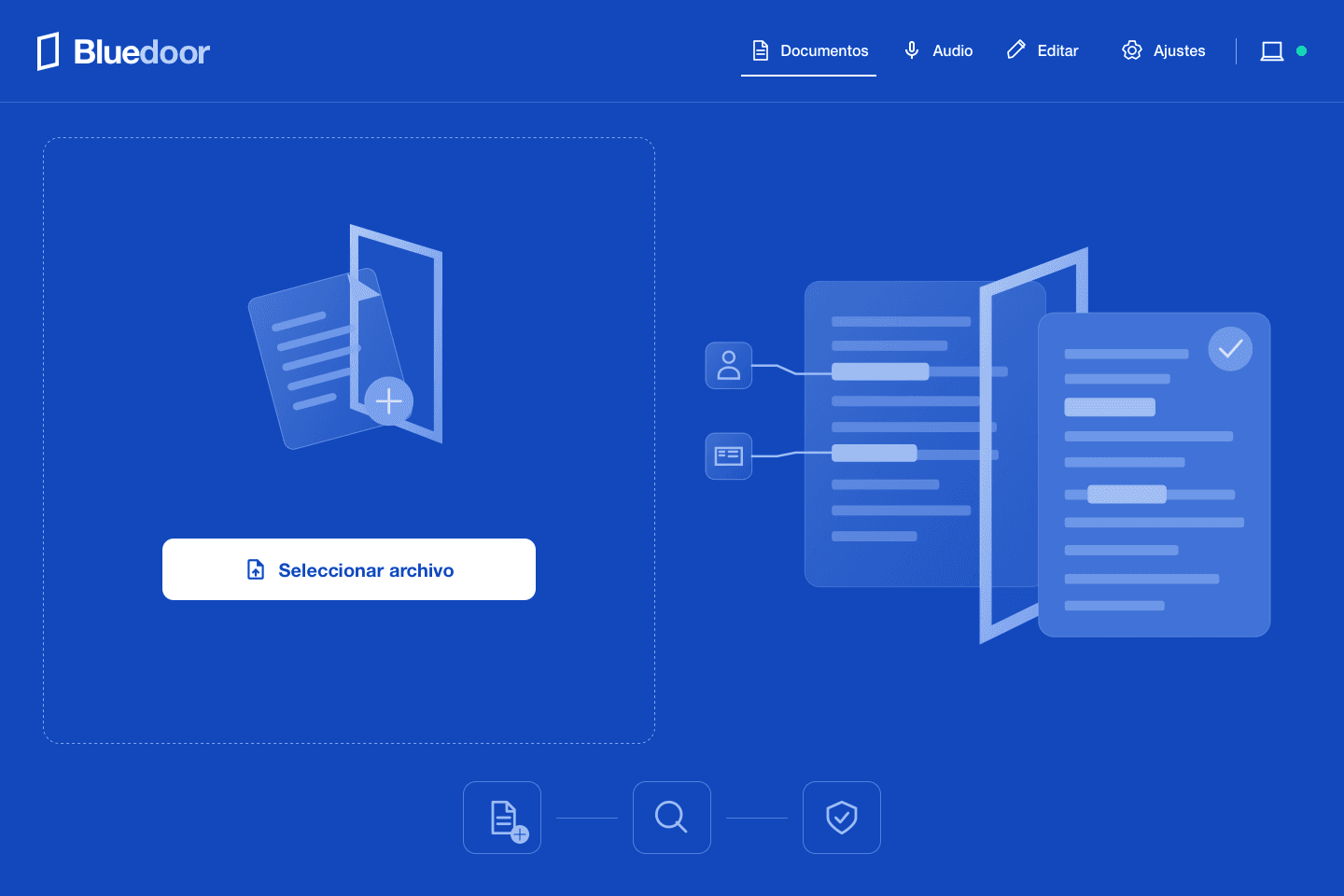
A lawyer wants help summarizing a contract in ChatGPT. In BlueDoor, they review the contract locally and replace a client name with an alias such as CLIENT_01, keeping that reference consistent throughout the document. They inspect every page, export the reviewed PDF and decide whether to attach it to ChatGPT. The original file and the private mapping are not automatically sent. BlueDoor prepares the material; the online AI service performs the subsequent analysis.
Local AI
Qwen3 suggests sensitive information for the user to review. Apple Vision provides on-device OCR for scanned PDFs and images on macOS. Whisper or NVIDIA Parakeet transcribes audio, and NVIDIA Nemotron can identify speakers with compatible local models. The document editor and native export checks operate locally. After the chosen models are downloaded, these preparation workflows can run offline. Transcribing audio does not anonymize the recording or remove a speaker's voice identity.
OpenAI
BlueDoor is designed as a complementary preparation layer for legal workflows using ChatGPT and OpenAI. Today, its ChatGPT button only opens the browser; the user manually attaches the exported file. A proposed next step is an opt-in OpenAI API connection for summaries, document questions and drafting from a user-approved, reviewed copy. That integration is not implemented. The design goal is to keep original files and the private alias map local, with explicit review of what would leave the device. BlueDoor is developed independently.
Stage
A working macOS prototype for Apple Silicon, available for private demonstrations with public source code on GitHub. The current focus is document review, export quality and the local-to-online handoff. Public installer distribution remains pending licensing evidence, Developer ID signing, notarization and clean-Mac validation. The repository includes an internal audit describing the checks performed and their limits.